
The Performance of Access
A Review of the 2026 Senate Democratic Creator Summit and the Limits of Proximity

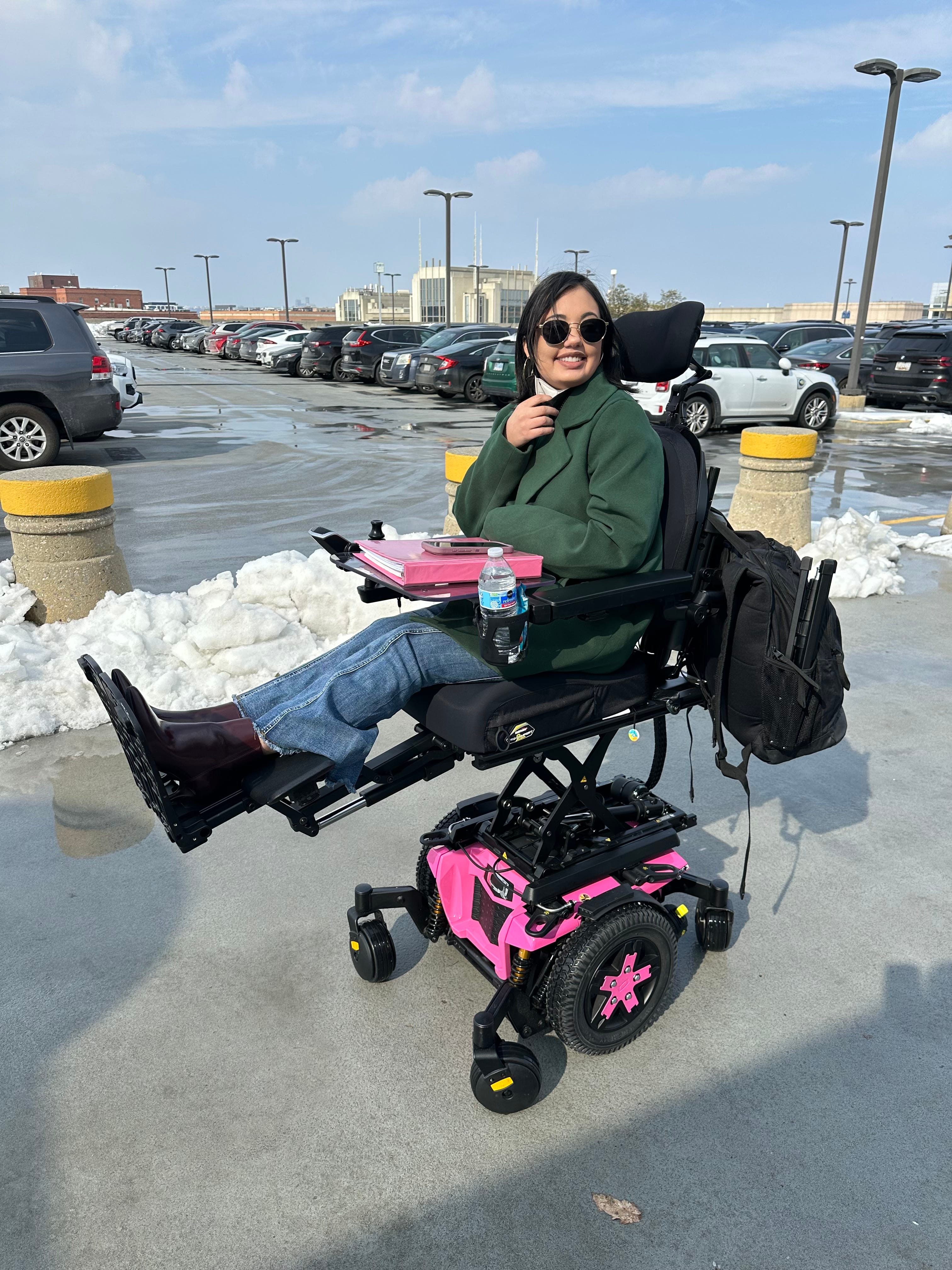
The trek begins before the summit.
Halfway up a frozen curb, wheels spinning, I pause, wondering if this will be the moment I turn back.
DC says “welcome” on its signs, but not for people like me. A snowstorm hit the city, and they were completely unprepared for the aftermath. As expected, disabled folks were the ones who paid the price.
Snowbanks block the sidewalk, and every obstacle demands I prove I belong there.
Before I hear a single speech, I’m already exhausted from the fight just to get there. I’ve lost count of how many times I’ve faced this—not just with the city’s physical inaccessibility, but with the institutions waiting inside those inaccessible buildings.
Note: Travel reimbursement and pay were not provided because the SCC Creator Summit is a federal government unit. Doing so would be illegal. I would not have attended if I didn’t live relatively nearby.
The invitation took me by surprise, and I was a bit skeptical. But since I lived less than two hours away, I decided to check it out.
The email invitation had encouraged attendees not to drive in, which makes sense in theory, given the Capitol’s security perimeter and limited parking.
But I don’t have the option of simply hopping on public transit and walking the rest of the way. I use a power wheelchair, and transporting it requires our accessible van.
I know that I am not alone in this; many other disabled creators and attendees face these same transit barriers every time they head to an event in the city. It’s a common, shared struggle that adds another layer of exhaustion even before we arrive.
It means each trip involves planning routes and coordinating relatives’ work schedules to help drive me.
Sometimes it takes an additional couple of hours or more for planning and preparation, not to mention the cost of parking in an accessible spot for the day.
Several roads near the Capitol were blocked, and the GPS kept rerouting us in ways that made no sense at all.
My husband had planned to drop me as close to the event entrance as possible so I wouldn’t have to navigate long distances in the cold, but between the closures and the barricades, that became infeasible.
The only viable option was to park at Union Station and walk from there.
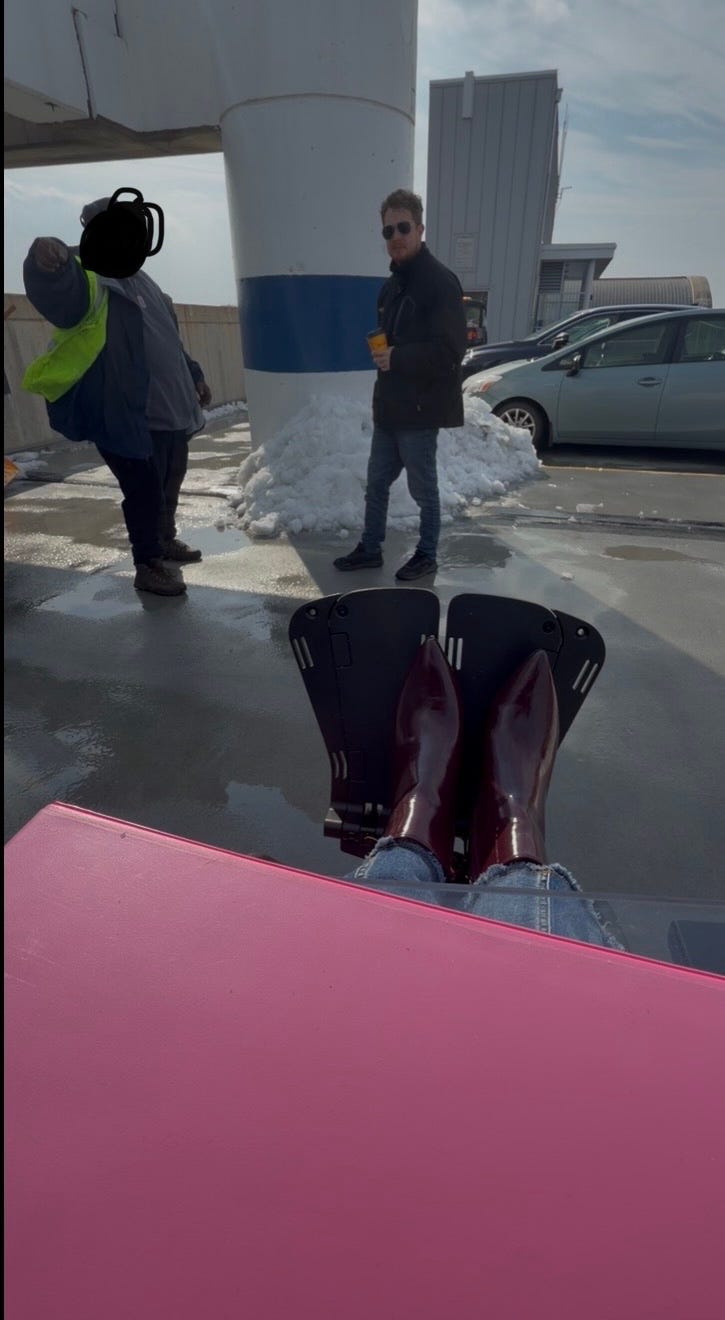
Getting out of Union Station wasn’t easy either. One of the elevators we needed to use to reach street level was completely blocked by hard snow.
The employees apologized, offered an alternative route, or we could wait 10 minutes while they cleared the sidewalk to the elevators. They were very kind and helpful.
By the time we reached the intersection where the crosswalk splits at the concrete island, we had already recalculated our route more than once. The snow there had been driven and walked over so many times that it had frozen into hard, concrete-like ridges. When my wheelchair hit it, the wheels couldn’t get traction. They spun while the chair shifted slightly beneath me, and I felt myself start to slide backwards.
Traffic was still moving in the adjacent lane. Four hundred pounds of literal metal (my wheelchair) cannot self-correct once it starts sliding.
If I tipped, there would be no easy way to get the chair upright again.
Plus, that would be dangerous to me.
My husband was behind me, trying to push without injuring his already damaged back. At some point, his mask fell into the snow.
People were waiting for the island to clear so they could cross. I was acutely aware that I was physically in the way while trying not to fall into traffic. I felt embarrassed and angry.
For fuck’s sake, we were just trying to get to a building.
I laughed a little because I found it painfully representative of life when trying to do anything as a wheelchair user.
Eventually, after several minutes of repositioning and my husband pushing, the wheels caught. The chair cleared the ridge, but by then, my hands were stiff, and my body was already losing energy.
And we were nowhere near our location yet.
Security and Entry
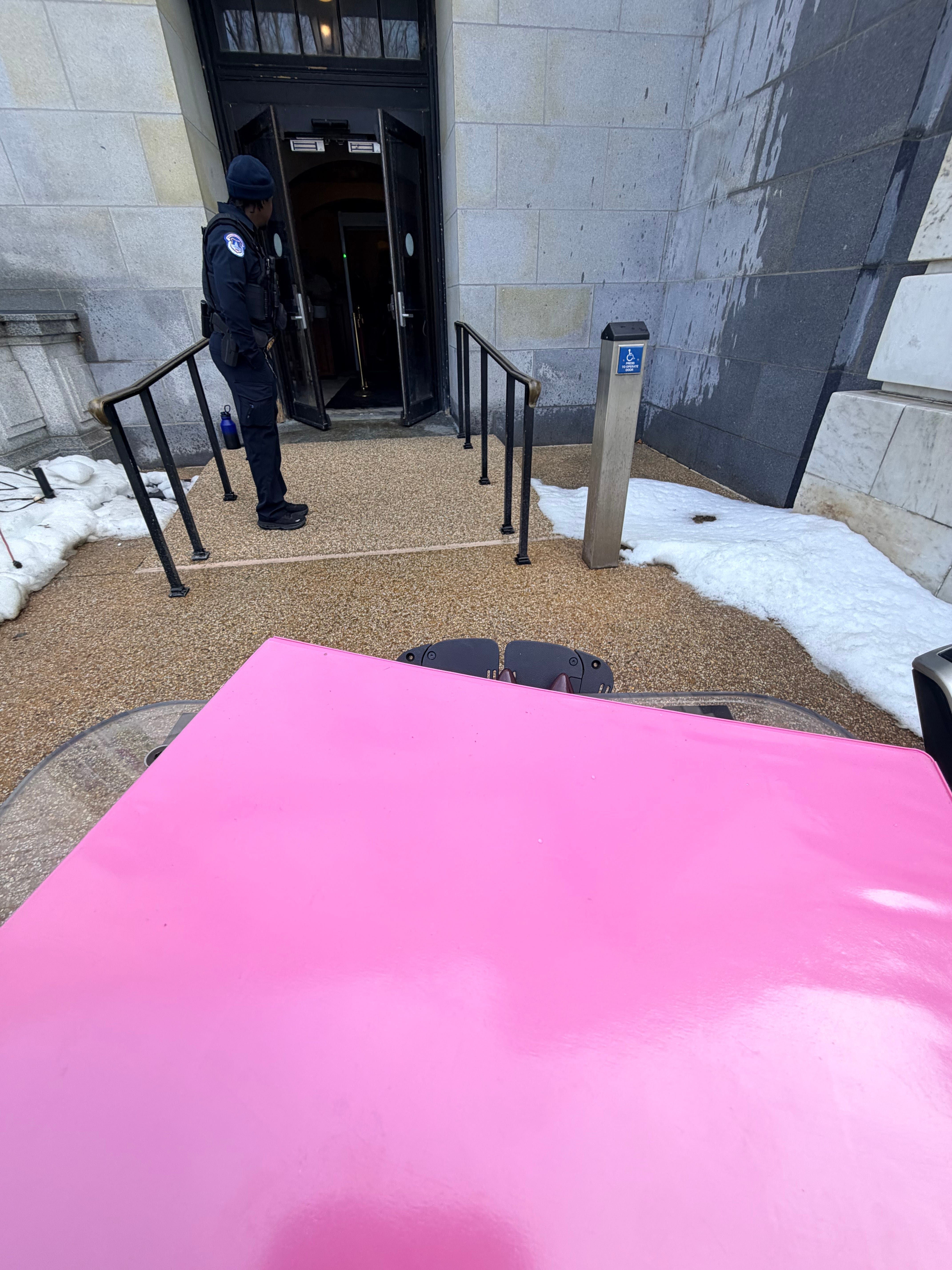
By the time we reached our location, my head was already throbbing. My hands and feet were aching from Raynaud’s. I was bundled up, but if you’ve been in D.C. the last few weeks, you know how cold it’s been. That kind of cold cuts through layers, especially since my body doesn’t regulate temperature well because of my nervous system damage.
I got in line to pass through security. Because I use a wheelchair, protocol required a female officer to conduct the pat-down. So, they had to locate one, which was no easy task.
So I waited in the cold while those who could walk went inside. I was told I needed to wait outside because my wheelchair might block a high-traffic area. The security guard looked at me and apologized without provocation, and I know it came from a place of feeling powerless to help.
I felt frustrated, invisible, and isolated.
This type of occurrence can make disabled people feel as if their presence is a problem. It leaves you feeling like a burden, and isolation clings even after you finally get through the door.
Eventually, the female officer arrived.
The search was thorough and lengthy, including private areas, which is standard for wheelchair users. It is not standard for everyone else because they can walk through the security scanners, but no such technology exists for wheelchair users. So, of course, we are treated like objects— as if we are the wheelchairs themselves and not a human in a chair. But I digress.
When I got inside, I felt a huge sense of relief. I was depleted, but I finally made it.
That physical relief, however, was quickly followed by the realization that the hardest part—actually participating in this space and being heard—was still ahead.
My body might have made it through the door, but my mind braced for the next set of barriers.
The Event Atmosphere
Inside, it was warm. That was the first thing I noticed.
My hands started to sting as they adjusted. My head was still pounding, but the immediate edge of the cold began to lift.
For a moment, I just sat there in my chair and let my body recalibrate, and I breathed in and out slowly.
The invitation email described the summit as an opportunity to hear directly from Senate Democratic leadership, meet with Senate Democrats to discuss priorities, and, of course, to create content and interview Senators through their “Creator Row”—an option many of us selected but wouldn’t find out we got it or not until we got there.
The room felt polished, with chandeliers hanging from the ceiling, and cameras everywhere capturing photos and filming. Things I had seen for years, but that have felt increasingly strange.
The “Pseudo-Event” and Don Lemon’s Journalism Speech
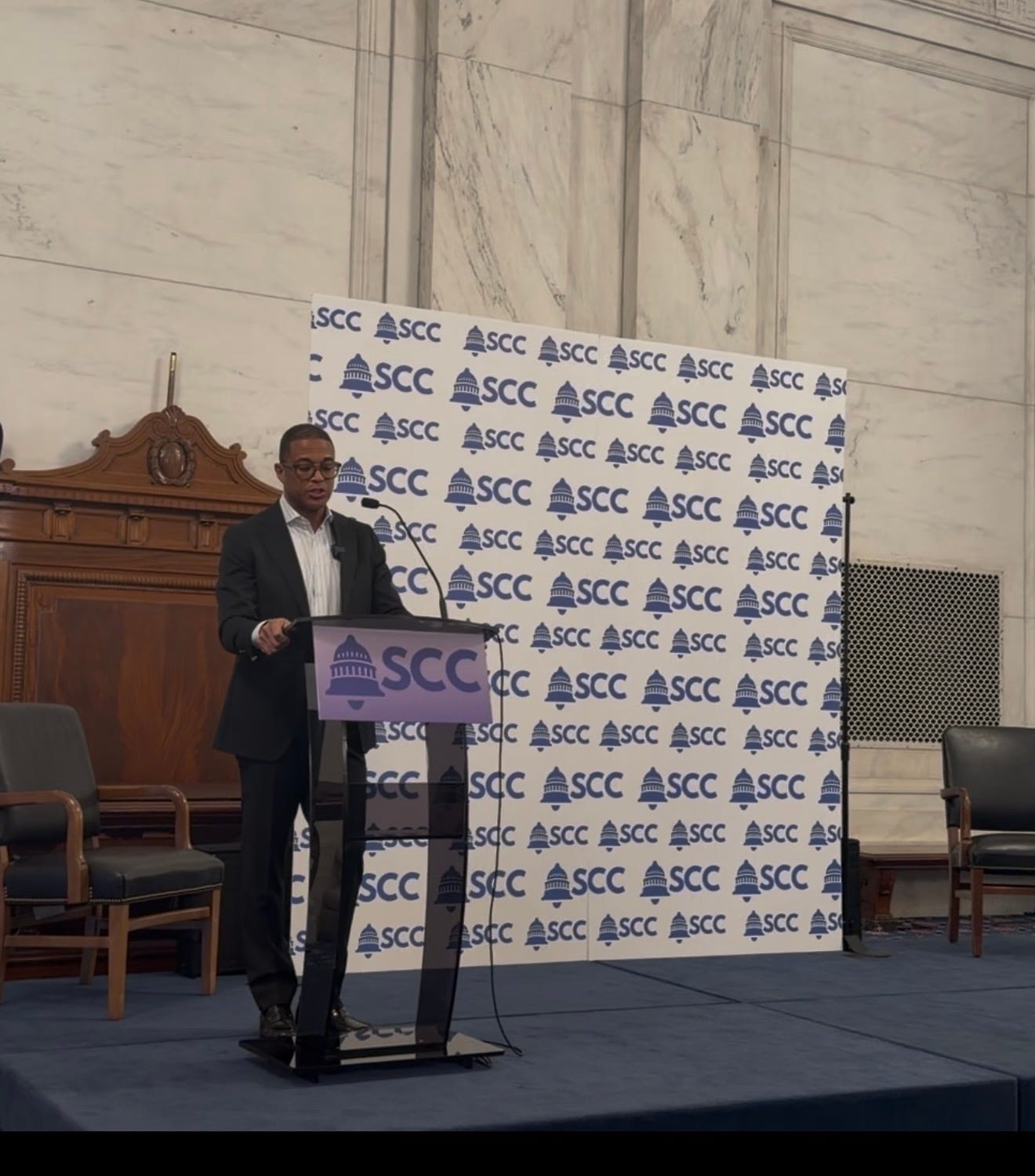
Don Lemon was one of the featured speakers, and his message—ironically—was about the necessity of friction between institutions and the media.
“If the press disappears, so does accountability,” he said. “When you refuse to stop asking questions, you refuse to let lies go unchallenged.”
He talked about the press being punished for telling the truth.
The line that hit the hardest for me was when he confidently stated that “the most dangerous thing to any authority is someone who refuses to look away.”
I agree with him. That’s why I, and many others, were there.
These types of events do offer real proximity. Senators spoke, and there were moments for photo ops where people lined up. But it was only an opportunity to quickly take a photo, no questions, keep it cute, and keep it moving.
It felt more like a press event for a celebrity-created beauty brand than a place for conversations to improve the public good.
With that said, proximity is not real access.
Daniel Boorstin described “pseudo-events” as events created primarily for the press.
They are often planned to be repeatable, built for images, and intricately controlled. The point is not to provide authentic access and conversation, but to identify what can be produced at these events that benefit the party and its goals. That can look like photos and cute, viral-worthy videos.
The idea of “pseudo-events” kept pressing itself on me as Don Lemon spoke about accountability and justice.
Accountability is what happens when you can press.
Pressing is what both prevents and brings about justice.
The structured events I have attended in the past narrowed what “pressing” could look like through their format.
Gatekeeping in the media is about who is allowed into the space, under what conditions, and how that shapes the narrative. Even when the environment “allows questions,” the structure can still filter dissent through limited time, rules about recording, staff-managed interactions, and the reality that the institution decides what happens next.
That’s why Lemon’s speech felt like it was echoing off the marble walls, yet not actually heard.
As I continued to listen, he said, “The idea that the state at any given day can decide that the truth is inconvenient and that the person telling the truth is the problem” is essentially dangerous and harmful to democracy.
Lemon’s focus on Trump is completely timely and appropriate.
Note: Don Lemon had recently been one of several Black journalists targeted and arrested by the Trump administration.
But I wondered if he recognized that pattern in past administrations as well.
The pattern specifically surrounding Palestine, Democrats, and the Biden administration.
Political leadership, especially when you look at history, has repeatedly treated truths as a “strategic problem” to be managed and silenced rather than confronted. They did it to people like Martin Luther King Jr., and Assata Shakur, for example. But that’s a whole other essay.
Accessibility, Ableism, and Group Dynamics
The summit’s version of “access” felt bizarre to me.
There’s a reason these events generate photos and cute viral moments more reliably than they generate accountability and constructive conversations.
The room affirmed the virtue of refusing to look away and fighting injustice, while the party itself refuses to look at injustice occurring in its own house.
As a part of my attendance, I was randomly assigned to visit a senator’s office with a group of other creators. The same task I’ve been assigned in other, unrelated events.
Being in those rooms with often starstruck and eager creators can be difficult. They privilege speed and the ability to process information in real time, formulate a response immediately, and assert themselves before the clock runs out or someone interrupts.
As an autistic person, I process information deeply but not always instantly. Additionally, the longer I sit up, the harder it becomes to think due to my condition, causing loss of blood flow and oxygen to my brain.
In high-pressure group settings, especially when the stakes are political and the room's energy is elevated, that processing window narrows. By the time I am ready to follow up, the conversation has already moved on.
Note: I did not attend the group meeting with a senator. I left an hour after I arrived because the event did not align with my goals as an independent creator with limited resources.
When I entered the building, I had already navigated snow, rerouted elevators, an intersection where my chair slid, and endured an extended wait in freezing temperatures because security protocol required a different screening process for wheelchair users.
Ableism is the cumulative impact of environments built for normative bodies. The result is not always overt hostility. The outcome often privileges those who can move quickly within it.
In other words, the closer you are to being able-bodied, the more access you receive.
Political Gatekeeping and Dissent
The dissonance I felt in that room did not begin that day. It began several years before.
I was new to the political creator space in 2020-2021, though not new to activism itself.
I was excited. I was, if I’m honest, a little star-struck, which makes me gag to say out loud, and that I’m certainly not proud of. But that was several years ago, and I was naive about how the system works.
I took photos. I stood next to senators. I really believed that this proximity meant that I would be heard. I believed that being inside the room meant being part of something.
Over time, it felt superficial. Especially because I was never really heard.
Then the attack on Israel and the genocide in Gaza happened in 2023.
I learned a lot about what the United States has done to the Middle East, and as someone who is a victim of colonialism, it enraged me.
Note: When Don Lemon said, “The most dangerous thing to any authority is someone who refuses to look away,” he was obviously talking about Donald Trump, but I also thought about Palestine and the Biden administration.
By November 2023, I became extremely outspoken on what was happening in Palestine—particularly on how it is a mass-disabling, genocidal event.
By Christmas 2023, I started publicly calling President Biden “Genocide Joe”.
When I began speaking openly about Palestine and the genocide, the tone shifted, and invitations stopped for a while.
I quickly learned that free speech in political spaces is often celebrated in theory but carefully censored in practice.
And I immediately noticed that I was not alone.
Creators and journalists who were openly critical of the Biden administration’s handling of the genocide in Palestine were excluded from events like the DNC and other similar events.
The message was that the institution could not be questioned, and it operated much like an authoritarian regime.
Political parties manage coalition stability by controlling message coherence and the appearance of unity.
That pattern is present with both Republicans and Democrats, and it is how institutions protect themselves.
Witnessing it from the inside over the years changes how you see everything.
What the Event Revealed
Toward the end of his speech, Don Lemon said: “The press is the foundation of the Constitution — if no one is allowed to tell the truth about power, then power answers to no one.”
Absolutely. In addition to that point, accountability rests not only on the press's existence. The constitution, in theory, is the foundation that allows the press to press (literally). And institutions are the ones tasked with enforcing that.
That’s part of the problem.
What I have learned as a disabled woman of color —especially in hospitals, classrooms, and in political rooms like this one — is that power rarely announces that it’s there for its own interests. It may be sold as being there for the people, but at the end of the day, the goal of power is to preserve itself, no matter what.
That is why we have to keep pushing against these institutions.
Thank you for this excellent essay. So powerful and reminded me of my similar experiences as a disabled person trying to be heard in these spaces owned by powerbrokers who do not honestly want to listen or open doors to others.
Thank you for sharing. As an autistic person with mobility limitations, I am always interested in the ins and outs of how other folks navigate access, not just in general but like literally moment by moment in actual spaces and systems (like you showed here)! Also, your chair is indeed "gucci"☺️